
About the Institute
History
In late 2021, the College of Engineering created an Energy Task Force charged with assessing existing energy-related activities at the University of Michigan, suggesting new initiatives to increase engagement, and recommending steps to catalyze strengths at the institution. The paramount and unanimous conclusion of the Task Force was to immediately create an Institute for Energy Solutions to address the needs and opportunities to strengthen our efforts on advancing global energy solutions.
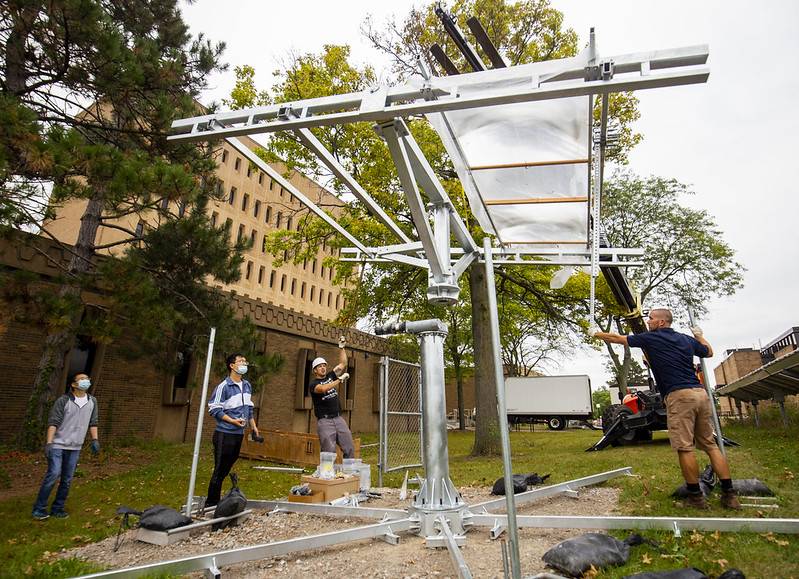
Seen above: Producing hydrogen from water and sunlight
Our Mission
The Institute for Energy Solutions (IES) aims to pursue energy science and technologies to enable, accelerate, and inform the transition to an equitable, resilient, clean, affordable, and sustainable energy future. By harnessing cutting-edge energy expertise and resources across the University of Michigan, IES aims to promote transformative research and innovations across the energy sector.
2025-2026 Strategic Research Pillars
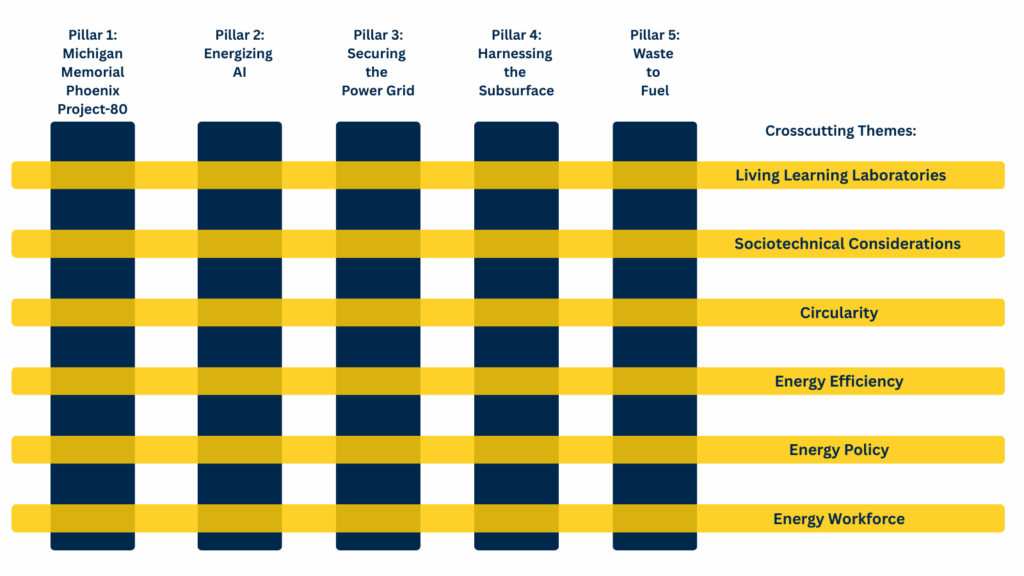
Over the 2025-2026 academic year, we aim to promote research that leverages the University of Michigan’s world-leading faculty expertise in line with our 5 Strategic Research Pillars and 6 Cross-Cutting Themes:
About the Pillars:
1. Michigan Memorial Phoenix Project-80 (Second-Gen Commercial Nuclear Energy)
We aim to leverage our #1 ranked nuclear engineering department in the country to support research, development, and deployment of a new “second-generation” of commercial nuclear reactors center.
2. Energizing AI (AI-Energy Nexus)
AI’s energy-intensive operations strain the power grid, raise energy costs, and reduce energy availability for other services. We need to take a holistic approach to modeling AI data centers, the grid, and AI-adjacent sectors, and how they intersect with social, economic, and environmental factors. We are working to support the development of fundamental computer science and power systems engineering technologies at the intersection of data centers and the power grid.
3. Securing the Power Grid (Power Grid Reliability and Security)
The grid is facing load growth, aging infrastructure, workforce challenges, cyberattacks, and an increase in natural hazards. IES aims to support research that brings together engineering, computer science, law, and policy researchers, and researchers who work with diverse communities to develop technology and regulatory solutions to strengthen and secure the power grid.
4. Harnessing the Subsurface (Geology + Energy)
The earth’s subsurface offers numerous possibilities for energy extraction and storage. We aim to support interdisciplinary research on: 1) coupling reservoir-scale modeling and energy systems modeling, 2) developing new approaches to identify optimal subsurface reservoirs for energy production/storage, 3) bench-scale experimental work to guide pilot-scale field testing, 4) materials research for extreme subsurface environments, and 5) novel subsurface drilling, storage, and extraction technologies, which will support domestic energy resources, both fossil and non-fossil.
5. Waste to Fuel (Biocatalysis to Turn Wastes into Biofuels)
Agricultural, forestry, and municipal wastes are abundant yet complex feedstocks that could be utilized, through innovative biotechnologies, to generate energy, particularly fuels. IES aims to support multidisciplinary research to develop methods to convert organic wastes to methane/bioproducts through next-generation anaerobic digestion technologies and to convert agricultural/forestry residuals and gas substrates to fuels/bioproducts through engineering of microbial or hybrid systems.
Each of these strategic pillars will be strengthened through integration of the following cross-cutting themes in our research efforts: Living Learning Laboratories, Sociotechnical Considerations, Circularity, Energy Efficiency, Energy Policy, Energy Workforce.